
Pelvic Heaviness Postpartum: Prolapse or Tight Pelvic Floor?
Feeling heaviness or pressure with exercise after birth? It may be prolapse, pelvic floor tension, poor pressure management, or a combination — and the right treatment depends on knowing the difference.
Returning to exercise after having a baby can feel complicated. Maybe you felt pretty good with daily life, but then you tried running and noticed pelvic heaviness. Or maybe squats, deadlifts, jumping, hills, or longer walks brought on a sensation of pressure, fullness, or heaviness. For many postpartum people, that feeling can be scary.
A common first thought is: “Is this prolapse?”
And sometimes, yes, pelvic heaviness postpartum can be related to pelvic organ prolapse. Prolapse can cause symptoms like pressure, heaviness, bulging, or a feeling that something is “falling out.” If you are newer to this topic, our Pelvic Organ Prolapse 101 blog is a helpful place to start. But here is the part many people do not know: Pelvic heaviness postpartum does not always mean you have prolapse, and it does not always mean prolapse is the main reason for your symptoms.
Sometimes heaviness, pressure, or the feeling of bearing down can come from a pelvic floor that is holding too much tension, having trouble relaxing, or not coordinating well with your breath, core, hips, and movement.
In other words, it could be prolapse. It could be a tight pelvic floor. It could be poor pressure management. It could be fatigue, constipation, core coordination, scar tissue, or exercise progression. And sometimes, it is more than one of these things happening together.
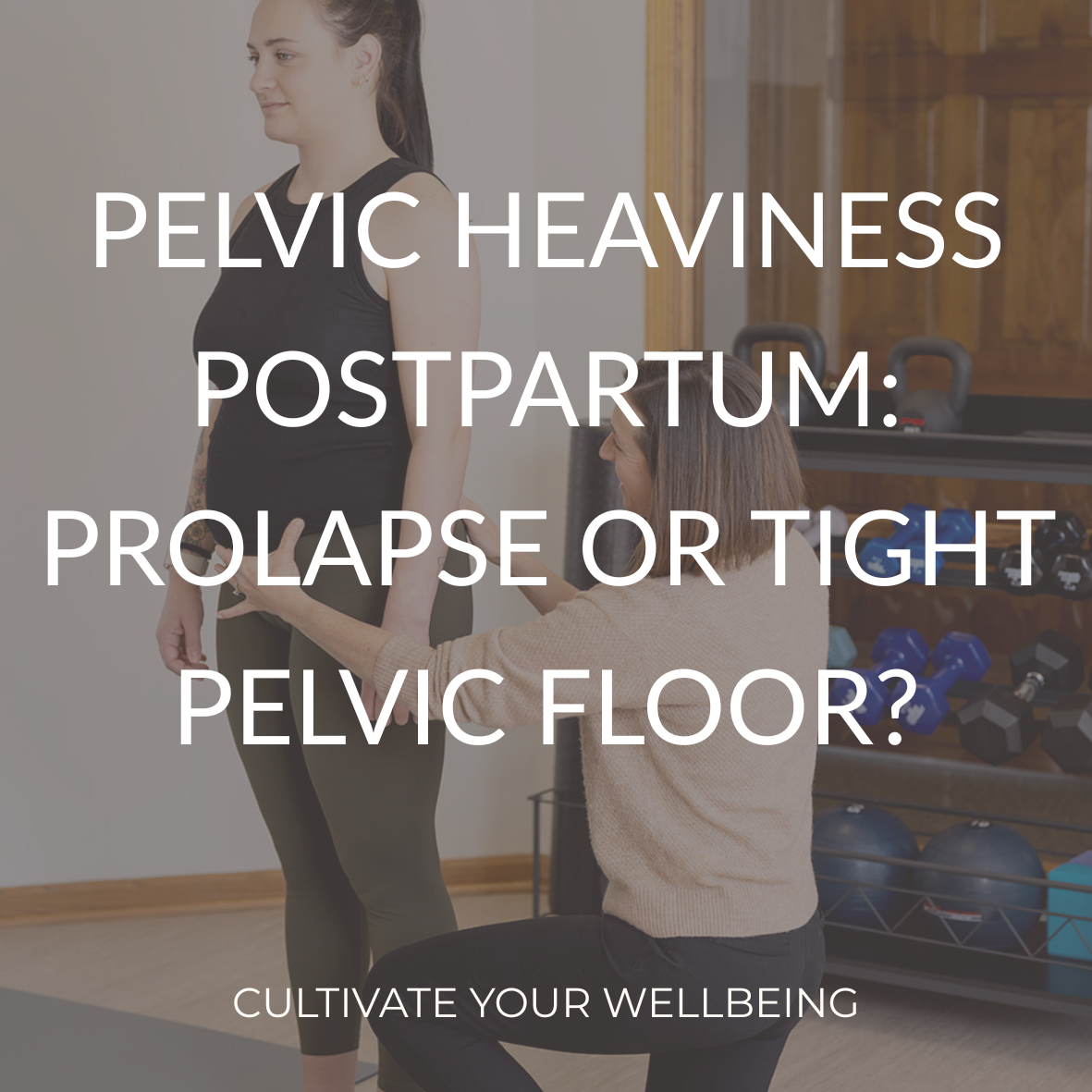
My Own Experience With Postpartum Prolapse and Exercise
This topic is personal for me, too. After delivering my twins, I experienced pelvic organ prolapse. When I started returning to exercise, I noticed heaviness with running and weight lifting. At first, it felt like the heaviness showed up with several activities. Over time, it became more specific — mostly with things like deadlifts, squats, and longer runs. Because I knew I had prolapse, it was easy to assume that every pressure symptom was coming from the prolapse itself. But through evaluation, clinical reasoning, and a lot of trial and error, I learned something important: My pelvic floor tension and coordination were actually contributing to my pressure symptoms more than the prolapse itself.That distinction mattered. Because if I had only treated the situation like a “weakness” or “support” problem, I may have kept doing more strengthening, more bracing, or more gripping — when what my body actually needed was better relaxation, coordination, pressure management, and gradual load progression. This is one of the reasons I care so much about a thorough pelvic floor evaluation. Symptoms can feel similar on the surface, but the “why” underneath them can be very different.
What Does Pelvic Heaviness Postpartum Feel Like?
People describe pelvic heaviness in different ways. Some say it feels like pressure. Others describe fullness, aching, bulging, or a tampon-like sensation. I have also heard several times "It feels like a golfball in my rectum" or "It feels like something is falling out". Some people feel it during exercise, while others feel it later in the day after being on their feet, carrying kids, or doing more activity than usual.
Pelvic heaviness may show up with:
Running
Squats, lunges, deadlifts, or lifting
Jumping or higher-impact exercise
Long walks or busy days on your feet
Carrying a baby, toddler, car seat, or laundry basket
Constipation or straining
Fatigue
Hormonal shifts, including around ovulation or before your period
The confusing part is that the sensation alone does not always tell us the cause. Two people can both say, “I feel heaviness when I exercise,” but one may need more pelvic floor support and strengthening, while another may need pelvic floor relaxation and better coordination. Many people need some combination of both.
Why Symptoms Matter More Than the “Stage” Alone
One of the most important things to understand about prolapse is that symptoms and anatomy do not always match perfectly. Some people have prolapse findings on exam and very few symptoms. Others may feel significant heaviness, pressure, or discomfort even when the visible prolapse finding is mild. This is why a good pelvic floor evaluation is not just about identifying whether prolapse is present. It is about understanding what you feel, when you feel it, what activities bring it on, and what changes those symptoms. At Cultivate Your Wellbeing, we care deeply about function. Can you walk, lift, run, carry your baby, exercise, have bowel movements, and move through your day with confidence? The goal is not just to describe anatomy. The goal is to help your body tolerate the demands of your real life.
Why Pelvic Heaviness Does Not Always Mean Prolapse Is Getting Worse
When you feel pressure or heaviness, it is completely understandable to worry that you are making prolapse worse. Many people feel a symptom during exercise and immediately think, “Did I just make things worse?” But symptoms are not always a direct measurement of tissue position. Pelvic heaviness can change for many reasons. It may show up when your body is tired, when you are constipated or straining more, when your breathing changes during exercise, or when your core and pelvic floor are not coordinating well with the task. It may be more noticeable when you increase intensity too quickly, add impact before your body is ready, hold your breath, grip your abdominal muscles, or return to certain lifts before your system has built the capacity to manage them.
Hormones, sleep, stress, scar tissue, birth-related tissue changes, and nervous system sensitivity can also influence how your body feels on a given day. This is one reason symptoms can fluctuate. You may feel fine one day and notice heaviness another day, even if nothing has “worsened” structurally.
So if heaviness shows up with a specific exercise, it does not automatically mean your prolapse has changed or that you damaged something. It may simply mean your body is saying: “This strategy is not working for me yet.” Not: “You made things worse.” That distinction is so important. It allows us to approach symptoms with curiosity instead of fear. Instead of assuming you need to stop exercising altogether, we can look at what your body needs: a change in breathing, load, position, recovery, pelvic floor relaxation, strength, coordination, or progression.
Can a Tight Pelvic Floor Cause Heaviness?
Yes, it can. And this was part of my own postpartum story, too. When people hear “pelvic floor problem,” they often assume the muscles are weak and need to be strengthened. But pelvic floor muscles can also be overactive, tense, guarded, or poorly coordinated. A “tight pelvic floor” usually means the muscles have difficulty fully relaxing or lengthening. Sometimes the muscles are working too hard at rest. Sometimes they grip during movement. Sometimes they contract when they should be relaxing. Sometimes they are strong in one way but not very adaptable. And muscles that are always holding tension do not necessarily function well.
Think about holding tension in your shoulders all day. Your upper traps may be “on,” but that does not mean they are functioning well. They may feel tired, tight, irritated, painful, and harder to relax by the end of the day. The pelvic floor does the same thing. If your pelvic floor is gripping, guarding, or bracing during exercise, you may feel pressure or heaviness because the muscles are not managing load and pressure efficiently. This is one reason why “just do kegels” is not always the right advice.
Prolapse and a Tight Pelvic Floor Can Happen Together
This is such an important point. Having prolapse does not automatically mean your pelvic floor is weak and loose. You can have prolapse AND a tight pelvic floor. You can have heaviness from support changes AND heaviness from pelvic floor tension or coordination issues. You can need strengthening AND relaxation. You can need to modify exercise temporarily without avoiding exercise forever.
This is where many people get stuck. They are told they have prolapse, so they assume every symptom must be coming from the prolapse. Or they are told to strengthen, so they do more and more kegels, even if their symptoms are not improving. But pelvic floor treatment is not one-size-fits-all. The goal is not simply to make the pelvic floor stronger. The goal is to help the pelvic floor become more responsive, coordinated, and adaptable.
Pressure Is Not Bad — Your Body Needs Pressure
Let’s talk about pressure for a moment, because this is another area where postpartum people often receive fear-based advice. Intra-abdominal pressure is not bad. Your body creates pressure when you lift, cough, laugh, sneeze, jump, run, carry groceries, pick up a child, or get out of a chair. Pressure helps create spinal stability and allows your body to generate strength.
The issue is not that pressure exists. The issue is whether your body can manage that pressure well for the task you are asking it to do. We talk more about this in our blog on pressure management for pelvic floor symptoms, which explains why pressure is not something to fear, but something your body can learn to coordinate.
Ideally, your diaphragm, deep core, abdominal wall, pelvic floor, spine, and hips all work together as you breathe, move, and manage pressure. If the pelvic floor is not relaxing, contracting, or coordinating at the right time, pressure may be directed downward in a way that creates symptoms.
For one person, the solution may involve improving pelvic floor strength and support. For another person, the solution may involve less gripping, less bracing, more relaxation, and better timing with breath. For many postpartum people, the answer is both.
Exercise Is Not Automatically Bad for Prolapse
If you have felt heaviness with exercise, it is understandable to wonder if you should stop lifting, running, or doing higher-impact movement. But exercise is not automatically harmful for prolapse. In fact, the right kind of exercise can be incredibly helpful. Strength, coordination, mobility, cardiovascular fitness, and confidence all matter for pelvic health. The key is not avoiding movement forever. The key is finding the right starting point, building gradually, and paying attention to how your body responds. This is also where your activity history matters. Someone who was already running, lifting, or exercising regularly before symptoms started is in a very different situation than someone who has been sedentary and suddenly decides to jump into heavy lifting or high-impact workouts. Your body’s current capacity, training history, strength, recovery, symptoms, and stage of healing all matter.
Research around exercise and prolapse is still developing, but what we do know does not support the idea that all lifting, running, or impact is automatically damaging. Some studies show small, temporary changes in pelvic support after exercise, but those changes do not mean long-term harm. This is very different from saying every person with prolapse should do every activity at every intensity. It means we need to be more thoughtful and individualized instead of fear-based. So rather than asking, “Is this exercise good or bad?” a better question is: “Can my body manage this activity right now with good support, coordination, recovery, and symptom response?”
For some people, the plan may be to temporarily reduce load, impact, range of motion, or volume. For others, it may be working on breath, core coordination, pelvic floor relaxation, or strength so their body can better tolerate the activity. And for someone who is early postpartum, newly symptomatic, very deconditioned, dealing with a more advanced prolapse, or recovering from prolapse surgery, the starting point may need to be much more conservative. That does not mean the long-term goal has to be small. It means the progression needs to match the individual.
Why Pelvic PT Should Look at the Activity That Causes Symptoms
If your heaviness only shows up with deadlifts, squats, running, jumping, or after a long day of carrying kids around, your evaluation should eventually consider those real-life demands. A pelvic floor can look and feel one way when you are lying down on a treatment table and behave very differently when you are standing, tired, under load, or moving with impact. That does not mean the table assessment is not helpful. It absolutely can be. But it is only one piece of the picture. This is why pelvic health physical therapy should not stop at checking the pelvic floor in one position. We also want to understand how your breathing, core, hips, pelvic floor, and movement strategy work together when your symptoms actually show up.
For example, if squats trigger heaviness, we may look at what happens when you change your depth, stance, load, or tempo. We may notice that you are holding your breath, gripping your abs, or keeping your pelvic floor “on” between reps. We may test whether exhaling during effort changes the sensation, or whether symptoms only show up once fatigue builds. If running brings on heaviness, we may look at how quickly you returned to impact, whether symptoms happen during the run or later that day, and whether walk-run intervals feel better. We may also assess hip, calf, and core strength, because the pelvic floor is not working in isolation. This helps us move away from generic advice like “just stop doing that” and toward a plan that actually fits your body.
What About Kegels?
Kegels are not bad. They are just not the answer for everyone. If your pelvic floor is weak, under-responsive, or having trouble creating support, strengthening may absolutely be part of your plan. But if your pelvic floor is already tense, guarded, painful, or having trouble relaxing, more squeezing may not be the best first step. Sometimes the first layer of treatment is helping the pelvic floor let go. That may mean working on breathing mechanics, pelvic floor relaxation, hip and rib mobility, scar tissue mobility, bowel and bladder habits, or nervous system downtraining. It may also mean practicing coordination before strengthening, so the muscles can learn when to relax, when to contract, and how to respond during movement. Then, once the pelvic floor can relax and coordinate more effectively, strengthening often becomes much more productive. This is why individualized evaluation matters so much. The goal is not to decide whether kegels are “good” or “bad.” The goal is to understand whether they are the right tool for your body right now.
Signs Your Pelvic Floor May Be Too Tight or Overactive
A tight or overactive pelvic floor can look different from person to person. For some, heaviness or pressure does not improve with kegels, but feels better when they change their breathing, soften their belly, or focus on letting the pelvic floor relax. Pelvic floor tension can also show up in other ways, including pain with intimacy, tailbone, hip, pelvic, or low back pain, urinary urgency, constipation, or difficulty fully emptying the bladder or bowels. Some people also notice they are clenching without realizing it — in the belly, glutes, jaw, or pelvic floor — especially when they are stressed, tired, constipated, or exercising at a higher intensity.
This does not mean you need to diagnose yourself. It simply means there may be more to the story than prolapse alone.
What Pelvic PT May Include
Pelvic health physical therapy for postpartum heaviness is not one-size-fits-all. Your treatment should match what your body actually needs. For some people, we may focus on pelvic floor relaxation, pressure management, breathing, manual therapy, scar tissue mobility, and helping the nervous system feel safer. For others, we may focus more on strengthening, coordination, return to running, or building tolerance to lifting and impact. Many people need a combination. We may also talk about bowel and bladder habits, constipation management, exercise modifications, and gradual progression back to the activities you care about. If a pessary or medical follow-up seems appropriate, we can help you have that conversation with your provider, too. Most importantly, the plan should make sense for you. Not everyone with heaviness needs the same exercise sheet. Not everyone with prolapse needs the same restrictions. Not everyone with a tight pelvic floor needs the same relaxation routine. A good plan should help you understand your symptoms, feel less afraid of your body, and build confidence in movement again.
You Do Not Have to Be Afraid of Exercise
If you feel pelvic heaviness postpartum, it makes sense to feel nervous about movement. A lot of people worry that every symptom means they are making things worse. But symptoms are information. They are not a life sentence. Feeling heaviness does not mean you failed. It does not mean your body is broken. It does not mean you should never run, lift, squat, jump, or do the things you love again. It usually means your body needs a better plan. That plan might involve a different starting point, a slower progression, a change in strategy, or more support in building strength, coordination, relaxation, and confidence. The goal is not to make you afraid of movement. The goal is to help you return to movement with more confidence. This is exactly the kind of individualized support we provide through pelvic health physical therapy at Cultivate Your Wellbeing.
When Should You Get Help?
Consider reaching out to a pelvic health physical therapist if pelvic heaviness keeps showing up with exercise, gets worse throughout the day, or makes you feel afraid to move. It is also worth getting help if the heaviness comes with bulging, pressure, leaking, urgency, constipation, pain, or symptoms that worsen when you try kegels. You also do not have to wait until symptoms are “bad enough.” If heaviness is keeping you from feeling like yourself, that is enough of a reason to ask for support. You deserve more than “just wait and see” or “just do kegels.” You deserve an assessment that looks at the whole picture. If you are earlier in your postpartum recovery or wondering what pelvic PT can help with after birth, you may also like our blog on why every postpartum person deserves pelvic PT.
Final Thoughts
Pelvic heaviness postpartum can be frustrating, especially when you are trying to return to exercise and rebuild strength. But the cause is not always as simple as “it must be prolapse.” Sometimes it is prolapse. Sometimes it is a tight or overactive pelvic floor. Sometimes it is poor pressure management, core coordination, constipation, fatigue, scar tissue, or exercise progression. And sometimes, it is all of the above. The good news is that these symptoms can often improve with the right support. At Cultivate Your Wellbeing, we help postpartum patients understand what their symptoms mean, return to exercise safely, and build confidence in their bodies again. If you are feeling pelvic heaviness, pressure, or uncertainty about exercise after birth, you do not have to figure it out alone.